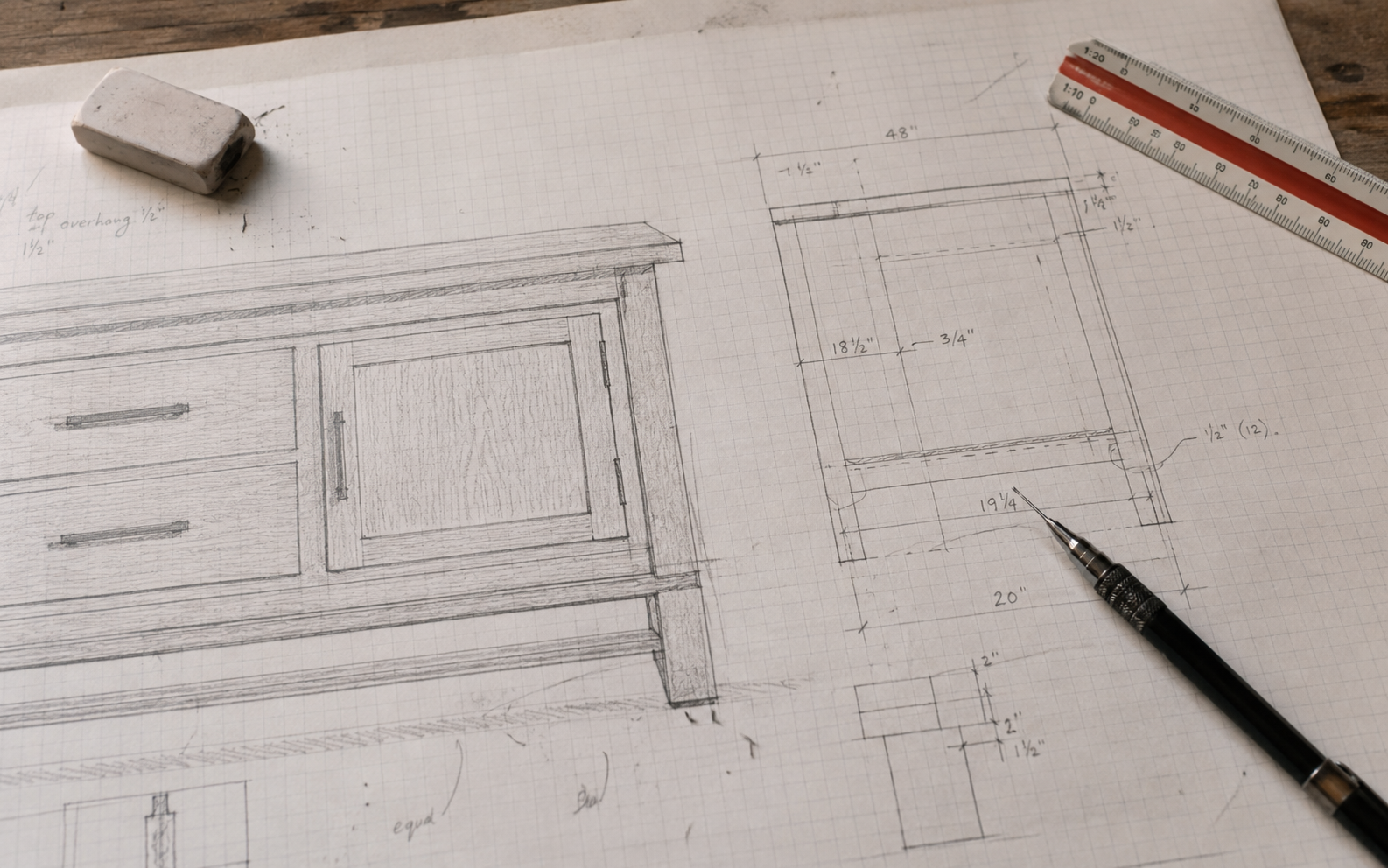
A pencil sketch of a side table forces decisions that SketchUp lets you defer. That’s the entire argument for the hand drawing, and it’s why every project in the library starts on graph paper before any wood gets dimensioned.
The software is faster — that’s the case for it, and it’s real. We use SketchUp too. But the speed comes from the software willingly drawing things you haven’t decided yet. A taper that’s “approximately like this” can sit in a CAD file for an entire week without you committing to it. The pencil drawing won’t let you do that. Either the taper is 1° or it’s 1.5°; either the apron is 4” wide or it’s 4½”. You can’t draw “around there.” The pencil makes a mark or it doesn’t.
The actual practice
We use 11×17” 5-square graph pads from a stationer in Pioneer Square, mechanical pencils with 0.5mm lead in 2H, a small architect’s scale (1:8 for furniture works well in inches; 1:10 in millimeters), and a vinyl eraser that doesn’t leave gum. Total kit: under thirty dollars.
We start with a rough thumbnail at 1:24 to settle proportions, then a working drawing at 1:8 with dimensions called out, then full-scale templates for any joint that needs verification. The full-scale templates get traced directly onto the stock — no intermediate measurement, no rounding error.
The whole sequence takes about three hours for a piece like a side table. Compared to the build time it’s nothing, and it pays for itself when you’re cutting the third tenon and the geometry just works.
What this isn’t
This isn’t an argument against CAD. CAD is essential for run-of-production work, anything with parametric joints, anything where the drawing needs to be a contract. For one-off furniture, where the drawing’s job is to make you certain, pencil is faster.
The certainty matters because the alternative is changing your mind in the middle of a six-hour resaw. Don’t change your mind in the middle of a six-hour resaw.